
...........Arminius....................Kalkriese....................... VARUS-Theorie ....................Hedemünden.......................Xanten............
Roms "arabische" Zahlen
I numeri "arabi" di Roma - Rome's "Arabic" numbers - Les nombres "arabes" de Rome
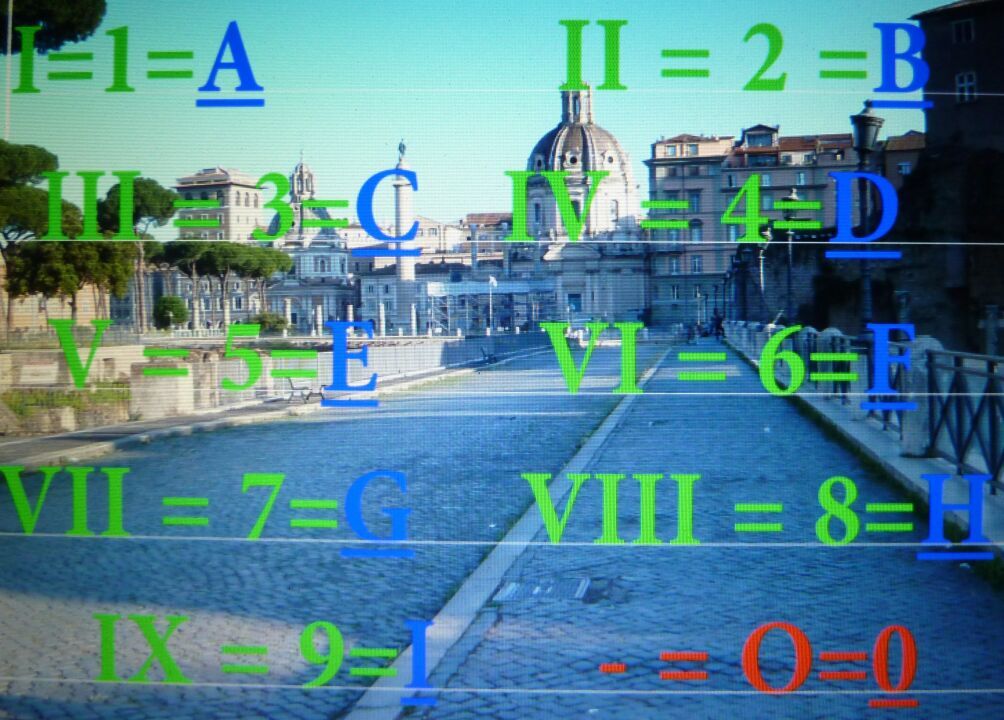
A = 1 ; B = 2 ; C = 3 ; D = 4 ; E = 5 ; F = 6 ; G = 7 ; H = 8 ; I = 9
O = 0 (Göttliche Zahl / Nichts und Alles -
Niente e Tutto -
Divine Number/ Nothing and Everything -
Nombre Divin / Rien et Tout)
Zur Kennzeichnung als Zahl im Text dient der Unterstrich;
Il trattino basso serve per identificarlo come numero nel testo Esempio della notazione ;
The underscore is used to identify it as a number in the text;
Le trait de soulignement permet de l'identifier comme un nombre dans le texte. Exemple de notation.
Rom - das "Preußen" des Altertums - werkelte über Jahrhunderte mit ziemlich "unhandlichen" Zahlen aus dem Lateinischen Alphabet (siehe unten) herum.
Roma - la "Prussia" dell'antichità - ha armeggiato per secoli con numeri piuttosto "ingombranti" dell'alfabeto latino (vedi sotto).
Rome - the "Prussia" of antiquity - tinkered around with rather "unwieldy" numbers from the Latin alphabet (see below) for centuries.
Rome - la "Prusse" de l'Antiquité - a bricolé pendant des siècles des chiffres plutôt "lourds" de l'alphabet latin (voir ci-dessous).
Auf Inschriften von antiken Gebäuden und christlichen Kirchen sind diese Zahlen bis heute nachzulesen.
Chiunque può ancora oggi leggere questi numeri sulle iscrizioni su edifici antichi e chiese cristiane.
Anyone can read these numbers on inscriptions on ancient buildings and Christian churches to this day.
Aujourd’hui encore, n’importe qui peut lire ces chiffres sur les inscriptions des bâtiments anciens et des églises chrétiennes.
Die eigentliche Frage:
WARUM
wurde eine solche INNOVATION der römischen Zahlenschreibung
NICHT
durch RÖMER erfunden?
TV-Beitrag
zum Thema mit diesem "Link": Roms-arabische-Zahlen
*****************La vera domanda quindi è: perché NON è stata inventata una tale innovazione nella scrittura dei numeri romani?
The real question is therefore: Why was such an innovation in Roman numeral writing NOT invented?
La vraie question est donc la suivante : pourquoi une telle innovation dans l’écriture des chiffres romains n’a-t-elle PAS été inventée ?
Roms wissenschaft-technische Elite, für die der Name VITRUV steht, baute das Pantheon, das Kolosseum, unzählige riesige Thermenbauten mit ausgeklügelter Wassertechnik, einen schnurgeraden Limes über viele Kilometer in Germanien und eine Wasserleitung aus der Eifel nach Köln mit einem so minimalen Gefälle, dass sie eine Wasserscheide überwand,
aber hatte nicht genügend kreative Kompetenz um eine solche Innovation zu entwickeln?
L'élite scientifica e tecnica di Roma, da cui prende il nome Vitruvio, costruì il Pantheon, il Colosseo, innumerevoli enormi bagni termali con sofisticata tecnologia dell'acqua, un Limes rettilineo per molti chilometri in Germania e un tubo dell'acqua dall'Eifel a Colonia con una pendenza così minimale da oltrepassare uno spartiacque, ma non aveva abbastanza competenza creativa per sviluppare una tale innovazione? Rome's scientific and technical elite, for whom the name Vitruvius stands, built the Pantheon, the Colosseum, countless huge thermal baths with sophisticated water technology, a dead straight Limes over many kilometers in Germania and a water pipe from the Eifel to Cologne with a gradient so minimal that she crossed a watershed, but did not have enough creative competence to develop such an innovation? L'élite scientifique et technique de Rome, dont le nom Vitruve représente, a construit le Panthéon, le Colisée, d'innombrables thermes immenses dotés d'une technologie de l'eau sophistiquée, un limes droit et mort sur plusieurs kilomètres en Germanie et une conduite d'eau de l'Eifel à Cologne avec une pente si minime qu'elle a franchi un tournant décisif, mais n'avait pas suffisamment de compétences créatives pour développer une telle innovation ?
Eine solche Änderung der Zahlenschreibung hätte nicht nur die römische Bürokratie entlastet, sondern auch die schriftlichen Kontakte innerhalb der Wirtschaft im Römischen Reich um das Mittelmeer und darüber hinaus deutlich erleichtert. (1)
Un tale cambiamento nella scrittura dei numeri non solo avrebbe alleggerito la burocrazia romana, ma avrebbe anche reso molto più facili i contatti scritti all’interno dell’economia dell’Impero Romano attorno al Mediterraneo e oltre. (1) Such a change in the writing of numbers would not only have relieved the Roman bureaucracy, but would also have made written contacts within the economy in the Roman Empire around the Mediterranean and beyond much easier. (1)
Un tel changement dans l’écriture des chiffres aurait non seulement soulagé la bureaucratie romaine, mais aurait également rendu beaucoup plus faciles les contacts écrits au sein de l’économie de l’Empire romain autour de la Méditerranée et au-delà. (1)
Gründe für eine solche Innovation in der Schreibweise waren somit gegeben, eine Umsetzung fand nie statt!
Warum nicht?
C'erano ragioni per tale innovazione nell'ortografia, ma non è mai stata implementata! Perché no? There were reasons for such an innovation in the spelling, but it was never implemented! Why not? Il y avait des raisons pour une telle innovation dans l’orthographe, mais elle n’a jamais été mise en œuvre !
(1): Im römisch-internationalen Handel gab es wohl "Krücken", (Symbole für Mengenangaben) um die lateinischen Buchstabenmonster zu umgehen, aber sie sind nur ein Beleg für die Notwendigkeit einer Innovation.
(1): Probabilmente nel commercio internazionale romano c'erano delle "stampelle", (simboli per le quantità) per aggirare i mostri delle lettere latine, ma sono solo la prova della necessità di innovazione. (1): There were probably "crutches" in Roman international trade, (symbols for quantities) to get around the Latin letter monsters, but they are just evidence of the need for innovation.
(1) : Il y avait probablement des "béquilles" dans le commerce international romain (symboles pour les quantités) pour contourner les monstres des lettres latines, mais ils ne sont que la preuve de la nécessité d'innover.
***********************************************************************************